
Fiction writers are piling into AI. Here's a look at how and why.
Plus, this week's AI news, as read by a marketer who plays bridge all day while AI does their work.


By Brandon Copple
It only took a few years for a clear consensus to emerge on AI writing: you shouldn’t do it. There are nuances. For instance: if you do it, you are in league with the devil. And: if you do it, you should die.
Meanwhile, tons of people are doing it. Many of them work at businesses trying to get efficient or pump more stuff out there without paying writers; many are scammers and spammers. And some are honest creatives trying to get writing work done faster or better than they could before.
Included in that last group are a growing legion of fiction writers. We know they’re growing because, look at the chart below, or spend three minutes on a Subreddit like r/WritingWithAI (181,000 members).
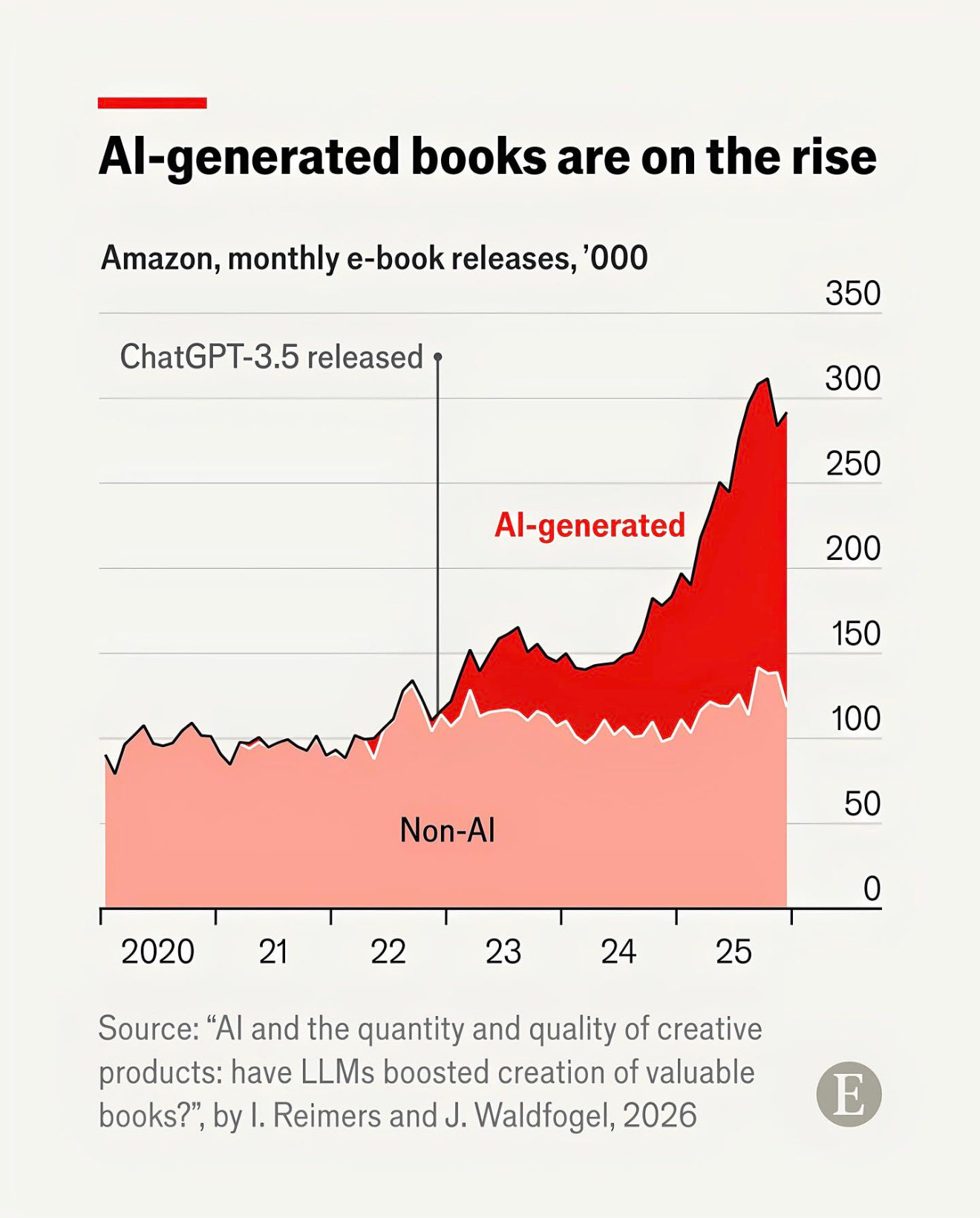
That aligns with a conversation I had last week with James Yu, a co-founder of AI fiction-writing platform Sudowrite, and a fiction writer himself. Sudowrite is pretty much a full-service fiction writer’s tool. You can use it to brainstorm, to get feedback, to write or rewrite for you. You can use it as a developmental tool, to flesh out — and keep track of — all the threads, characters, and timelines in a story. All of this using an AI model trained on story structure, character development, pacing, genre conventions, and other parts of the novelist’s craft.
James says Sudowrite has been growing “steadily” since he and Amit Gupta founded it in 2020 — despite an ugly 2023 backlash that included, amongst the usual vitriol, death threats against him. The outrage arose with the launch of Story Engine, a tool that could create a draft of “an entire novel in just a weekend,” as James described it in the launch video.
But at the height of the backlash (mostly on Twitter), James says interest in Sudowrite was also hitting all-time highs for customer signups. Turned out, for every apoplectic commenter there were a handful of writers who heard about Story Engine and just thought “I wonder if that’s useful.”
“They didn’t comment, they just went and checked it out,” James says. “If it worked for them, they subscribed. It was a pretty big deal for us.”
It’s a microcosm of the split-screen moment we’re still living in. It’s not uncommon to hear your favorite podcaster or artist or writer say “everyone hates AI,” and the polls more or less corroborate that. AI has destabilized the workplace and overwhelmed every platform.
And yet, more and more people are using it. Not only for optimizing tasks, glorified Googling, and cheating at school. Tons and tons of creative people are using AI to make stuff. Sure, some use it to mass-produce content fast, which is what social platforms, Kindle Unlimited, and online advertising pay you for. But others use it to make content and art. They’re usually amateurs, they mostly work alone, and they’ll take any help they can get, including from AI.
We serve video creators and podcasters like that at Descript. When I met James I was interested to get his insider’s perspective on the fiction-writing world, where the work is changing, the output is exploding, and the discourse is flaming.
Here’s an edited version of our conversation.
What kind of writers are using Sudowrite, and what are they writing?
There are two big groups. One is writers in certain romance subgenres where readers are genuinely voracious — we’re talking multiple books a day — and they don’t care if AI is involved, they just want more content. Those writers treat it almost like a studio model. They’ll look at Amazon, see what’s popping off this week, and where there might be a gap in the market. They’ll use Sudowrite to scaffold entire novels as fast as they can. It’s like fast fashion.
The other big group is writers who barely use any generated words in their final manuscript. They’re in the Story Bible [Story Engine’s successor], developing characters and world-building, chatting with the AI about plot problems, thinking through series arcs. It’s purely a thinking partner for them.
Everyone else is somewhere in between those humps, on their own path — there are as many paths as there are writers. A lot of our authors have multiple pen names and use AI differently for each one.
Writing a novel is obviously a wildly creative act. But it’s also a big project that requires project management — keeping track of timelines, character continuity, making sure you don’t repeat yourself.
Yeah, and a lot of the famous authors out there employ people to basically keep track of all that. We think everyone should be able to have that — to be able to help check their manuscript for mistakes, going beyond spelling and grammar. The AI can go in and highlight any of the places where you maybe introduced some kind of continuity problem, or a problem with the rules in your universe.
We have a feedback tool where, for example, if you wanted to look at a particular chapter and say, “does this introduce any plot holes?” it can do that. We also have custom prompts you can put in to say, “here’s my magic system — does anything in this chapter or section violate those principles?”
The AI helps you catch these little mistakes that your readers are definitely going to catch.
I like running my writing by AI because it’s completely objective and there are no emotional stakes — it can tell me my writing is bad, or I can completely ignore its feedback, and either way I feel nothing, in a good way.
There’s an interesting facet of working with AI where you can be more honest with it, and with yourself. You aren’t posturing. Even with the people you trust the most, there’s always part of you that wants to impress them. But you don’t need to show off to AI. We see a lot of folks being like, “I just tell the AI to be as cruel as possible because all my friends aren’t honest enough.”
Also, novelists are notoriously very lone-wolf. A lot of our early feedback was that this is almost like a mental health tool. I remember one author saying something like, “Even my wife won’t read my writing anymore — she’s seen too many drafts. But Sudowrite is up 24/7.”
What’s your advice for writers who want to use AI but don’t want to produce slop or just middle-of-the-road work?
We always say: you’ve got to bring as much of yourself into the process as possible. Your idea, your characters, your half-written draft — whatever you have. We have a lot of tools that can help you with structuring your novel, fleshing out characters and details.
And like sure, you can click a button and say “write me a fantasy novel with dragons,” and it will. But it’s not going to be you. The people who get the most out of it are bringing their entire half-written novel, doing deep dives in the chat, tuning the style. The more of yourself you bring into the process, the more it’s going to sound like you. And of course, you have to edit. We tell our authors: don’t come to us thinking it’s a push-the-button get-a-novel machine.
You’re also training your own AI models. Why go to all that trouble when Anthropic and OpenAI are serving up these incredibly advanced models?
We do make the big labs’ foundational models available to our writers. But we built Muse [Sudowrite’s proprietary model] because the foundational models are getting worse for creative writing. They’re being RLHF’d1 for enterprise tasks — coding, emails, reports. That makes sense economically, but it diminishes the utility for creative work. Good writing needs strong pacing, it needs intrigue and humor, it needs unpredictability. The earlier models were better at that. Even the hallucinations and weird responses — those things can be useful for fiction writing.
A lot of our fine-tuning work at this point is essentially trying to undo some of what the big labs are doing. It’s going to be a forever war, because the things artists need and the things enterprise customers need are genuinely in tension.
Why would you use the same model for your art that billions of other people are using to generate quarterly reports? By definition you’re getting the same ideas they are.
I have a theory that maybe every novelist, every artist, eventually has their own model — one that understands their taste over time. And then you have to get better at prompting it, you develop all these notions of how to talk to it — but it should really just work as a natural assistant, something that knows your brain, that’s lived and breathed your work.
There’s an artist I read about who trained a model on choir recordings and then made this weird new music with it. They stuck it in a museum, so people could make music themselves.
I think we’ll see more of that, because there are weird, fringe models out there that don’t write or sound like the mainstream ones, and those might become tools specifically for artists who want to get away from what everyone else is making.
I also think language models could create a new kind of literature, like with language models as authors themselves or authors training their own models that then proliferate and write different books. But we’re not really close to that yet; some artists are just on the fringes of something like that, but the art of literature doesn’t change very fast — certainly not as fast as Silicon Valley seems to think it will change.
Where do you hope all of this leads?
My hope is that AI being good at simulating common literary patterns actually pushes writers to be more weird. Like if AI can do all the tropes of fiction really well, maybe creative writers will push themselves harder. Similar to how photography pushed painters toward impressionism. What is the impressionism of writing? There are fringe things out there now, but maybe those will become more mainstream and maybe audiences will gravitate toward them because they’re so inundated with the same style. I think that would be cool.
What fresh hell
This week’s AI news for creatives, as summarized by the Claude chatbot, given this prompt:
You are a product marketing manager who uses AI to generate everything, hasn’t done any work of their own since November, and spends most of their workday playing bridge online.
More than three-quarters of marketers say they spend at least three hours a week editing, fact-checking, or correcting AI-generated output, according to a new survey, and 30% say they frequently pass off AI-generated work as their own, and now you know how I’ve spent the last three hours finessing a 4-3 trump split while my Slack status says "deep work." Only 41% of workers say their employers have trained them to use AI at work, which tracks, since my onboarding was a Loom video I watched at 2x speed between rubbers. Tidal said it wouldn't pay royalties on AI-generated music, and AI music startup Suno launched an incubator for independent artists that requires granting derivative rights in exchange; I'd sign away derivative rights to my entire Q3 deck for one clean squeeze play. Ford rehired 350 veteran engineers after AI-assisted design underperformed, and Meta plans to shift most of the responsibility of moderating harmful content to AI, which is fine, someone should be watching something, because I haven't opened Canva since November. AI-video startup Higgsfield is in talks to raise $500 million at a valuation of $5 billion, and the head of OpenAI's Codex acknowledged that AI isn't good at creative design, “for now” — let's give it up, once again, for the human brain, currently open in another tab, bidding three no-trump.
Reinforcement Learning from Human Feedback, an AI term for the way they train models. Can also refer to Ralph Lauren Home Furnishings, a decorating motif where all the chairs are saddles.